
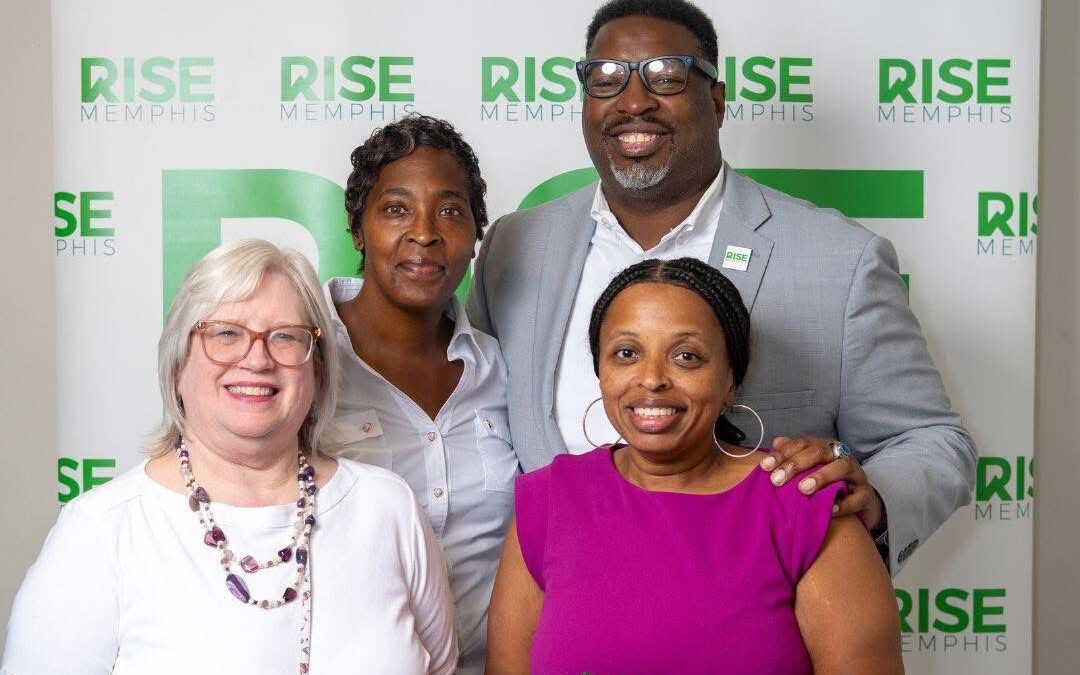
How Malcolm Rawls helps Memphis RISE
By Josh Crawford, Special to The Daily Memphian
Booker T. Washington High School senior Anatasia Norris has been part of RISE Memphis’ Goal Card Program since 5th grade.
Through the program, which serves more than 400 students in five partner schools, RISE matches or even doubles the savings students accumulate over the school year. Students also earn points for academic, financial or other achievements.
“I feel (without RISE), I would have been spending money on nonsense that I don’t really need,” Norris said. “As a girl, we like to have our hair done, nails done, but I can sacrifice that sometimes to put some money up for future needs.”
RISE, which began in 1999, stands for Realizing. Income. Stability. Empowerment. and is a 501(c)(3) dedicated to promoting financial literacy and helping local families build assets and make better financial choices, according to its website.
“For me, our biggest goal is to give the opportunity to Memphians to live here and thrive here financially,” said Malcolm Rawls, the organization’s executive director since October 2024. “That pursuit is so person to me, and to us, because there are so many Memphians doing the right things, but still not5 being able to make ends meet.
Three words
“Intelligent. Assertive. Reliable.”
Those are the three words former Arizona Cardinals NFL player Dan Williams used to describe Rawls, his longtime friend and former East High School teammate.
October marked one year since Rawls took the helm of RISE Memphis. In that time, he’s expanded staff, strengthened partnerships and refined RISE’s mission to help Memphians not only understand money, but to use it as a tool for empowerment and long-term stability.
“Living here, being a native Memphian, being entrenched in the culture and community, I try to be intentional about hearing the voice of the community, and that’s what has guided me,” Rawls said.
For Rawls, that drive is deeply personal. Raised in the Binghampton neighborhood by a single mother who worked multiple jobs, he saw firsthand the stress of financial strain — and how commonplace it was for everybody around him. That early observation became the foundation of his drive to make financial education more accessible and sustainable, in order to give back to a city he feels he owes his life to.
“Memphis has given so much to me,” he said. “Be it the education I have, the athletic path I was allowed to pursue. So, with it giving me so much, I’m committed to being a positive, driving force in the growth and the upward trajectory of this place.”
A foundation in leadership
Long before he even knew what his post-athletic career would look like, Rawls was laying the groundwork for it. During his senior year at East High School, he began organizing after-school study sessions for his football teammates, many of whom had Division I talent but struggled academically.
That effort caught the attention of local philanthropist Charles McVean and led to a meeting that changed the course of Rawls’ life.
“I just thought he was another recruiter. I thought he’d come in from Vanderbilt,” Rawls said of McVean, laughing. “I was just listening to his pitch, and I was confused because it wasn’t based around any school. We weren’t talking about football; he was just laying out what appeared to be a dream for East. I finally was like, ‘Where do I fit into all of this?’”
That was in 2005 and McVean had just founded the Peer Power Foundation, a tutoring and mentoring model that has since reached more than 12,000 students across Shelby County. Rawls credits that experience, working for Peer Power while a University of Memphis student, as his first exposure to purpose-driven leadership and public service.
“That feeling, that gratitude I got from that moment was life-changing,” he said. “I was used to those athletic achievements … but seeing my teammates come in with their grades, getting their tests improved, and being able to walk across the stage, that made me feel like a real winner.”
Culture and continuity
When Rawls became executive director 13 months ago, he stepped into an organization with an established history. But during his first year, he’s added five new staff members while retaining all of staff from the previous leadership — something he views as a major reflection of trust, alignment and shared mission.
Adrianne Moore, who coordinates the Goal Card Program, said Rawls’ arrival brought a needed energy.
“When Malcolm came in, it was almost like a new frontier, with fresh ideas and another level of creativity,” she said.
“You talk about his athletic skills transferring, it definitely felt like a new coach coming in,” Moore added. “He didn’t have any plays in the playbook yet, but he saw the team that he already had.”
Moore said there’s been a high level of turnover in the past, but Rawls’ leadership has stabilized the organization.
“With him being able to keep everybody, I see him being here long-term,” she said.
And when asked, her three words to describe Rawls were resourceful, optimistic, and grounded.
Christopher Davis, president of LeMoyne-Owen College, has been a RISE board member for nearly a decade.
“What stood out about Malcolm was his energy and enthusiasm around what we do both in the nonprofit and education space,” Davis said. “Let’s face it, nobody’s jumping up and down to raise money. But even when we talked about some of the historical challenges we’ve faced, he wasn’t shaken or deterred. Every time, the response was, ‘Yeah, OK, we can do that.’”
Davis said Rawls struck a balance between respect for RISE’s past and ambition for its future. “Malcolm didn’t, and didn’t want to, come in and dismantle or disregard ho we are and what we’ve done before,” Davis said. “What he’s been able to do is come in with his twist on some of the things we were doing.”
“The board is really excited about our direction,” Davis continued. “The commitment to moving people into home ownership, teaching young people how to save, and how to manage their assets. It’s exactly what we’re supposed to be doing.”
Building a legacy
Under Rawls’ leadership, RISE has expanded programs such as Money Mondays, a weekly financial literacy series RISE does with six Shelby County public schools, and the Goal Card Program. Both programs maintain a 100% graduation rate in the process.
Like Norris, Booker T. Washington senior Damarcus Carter has also been in the Goal Card Program since fifth grade.
“It just made me want to work harder,” Carter said. “The activities they have for us, the things that we do, and the way that they push us to do better — it made me want to shoot for higher grades and more.”
Both students said RISE changed how they view money.
“I’ve learned that I don’t really have to overly do it,” Carter said. “Saving is way better and helps later, more than buying stuff I don’t really need.”
But, Rawls said, the organization’s greatest obstacle isn’t teaching financial literacy — it’s breaking the stigma around it.
“So many people in Memphis, unfortunately, are pros at managing poverty,” Rawls said. “The biggest challenge is breaking the shame and stigma around asking for help with money and money management.”
That, Rawls says, is how RISE plans to move forward: one conversation, one family and one generation at a time.
Nearly two decades after his first meeting with McVean, Rawls said he still feels guided by that same sense of purpose.
And that resonates with others.
When asked for his three words to describe Rawls, Davis cracked a wide smile and leaned over the large mahogany table in his office, as if he was ready to reveal a secret. He lifted his hand, counting each word as he spoke.
“He. Gets. It.”
Recent Comments